
Elves
Species 003 · Elves — long-lived, lean, and precise beyond human measure
Long-lived, lean people with pointed ears and exceptionally precise bodies: balance, coordination, and touch beyond human measure, healing that leaves almost no scar, and water and food needs far below a human's. Their bones outlast nearly everything else about them — and age arrives slowly, never suddenly.
Developed — physical, healing, sensory, and metabolic foundations established; food-deprivation tolerance remains open.
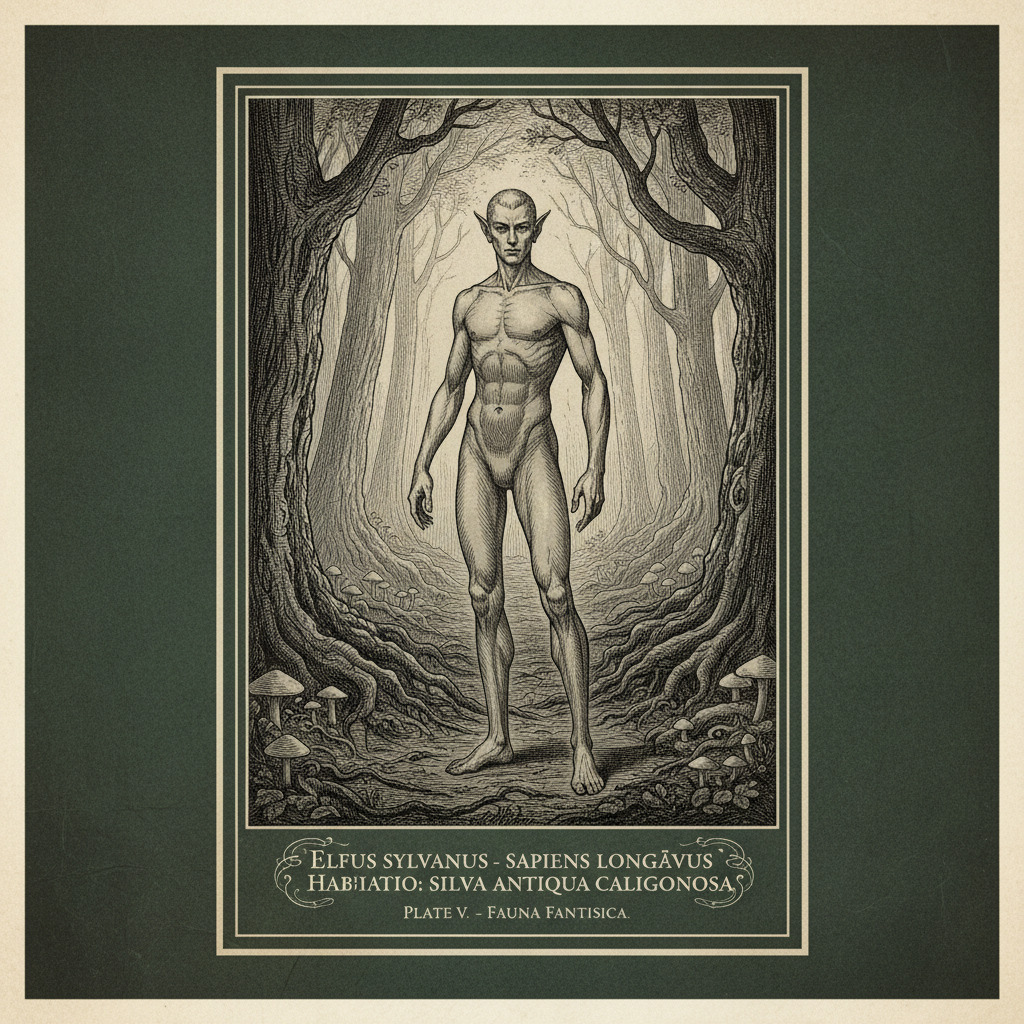
Appearance and body structure
Overall appearance
Recognizably elven, with otherwise humanlike form.
Face
Subtly different facial proportions from humans.
Ears
Pointed.
Height
Typically 5 feet 10 inches to 6 feet 8 inches.
Build
Generally lean and athletic.
Weight
Typically 120–190 pounds.
Skeleton
Lightweight bones with specialized internal architecture that preserves strength.
Life history
Natural lifespan
Typically 300–500 years.
Physical adulthood
Approximately 18–21 years.
Visible aging
Generally becomes more noticeable around 200–250 years.
Performance decline
More noticeable and gradual around 300–350 years.
Skeletal aging
Exceptionally resistant, through specialized bone maintenance and remodeling.
Biology
Strength
Moderately stronger than similarly built humans, with training and individual variation.
Agility
Exceptional balance.
Coordination
Exceptional proprioception — exceptionally precise movement and neuromuscular control.
Running speed
Exceptional, without an established numerical maximum.
Endurance
Exceptional sustained exertion, though rest and recovery are still needed.
Bone healing
Moderately accelerated; fractures remain serious injuries.
Skin and soft tissue
Heal exceptionally rapidly through specialized tissue-repair mechanisms.
Scarring
Skin generally heals almost completely without scarring; permanent scars usually require exceptionally severe or unusual injuries.
Pain
Naturally reduced sensitivity — which does not reduce injury vulnerability.
Touch
Exceptionally precise tactile perception, from specialized receptors and neurological processing.
Temperature perception
Exceptionally precise, through the same specialized receptors and processing.
Thermoregulation
Exceptionally adaptable across a broad range of hot and cold environments.
Water conservation
Exceptionally efficient; needs are substantially lower than in comparable humans.
Dehydration tolerance
Enhanced — though severe dehydration remains dangerous.
Thirst
Broadly human-comparable, calibrated to lower water needs.
Metabolic efficiency
Exceptional; food needs are substantially lower than for humans of similar size and activity.
Nutrition
Food, water, rest, and nutrients remain necessary for healing and survival.
Magic and glamours
Established facts
No species-specific facts have yet been established.
Society and culture
Established facts
No species-specific facts have yet been established.
Notable individuals
Established facts
No species-specific facts have yet been established.
Hard boundaries
What this entry must never become, however the story grows.
Reduced pain must not be written as immunity to bleeding, shock, burns, fractures, or dangerous injury.
Precise touch and temperature detection must not imply constant discomfort.
Precise touch must not imply automatic mastery of delicate tasks.
Efficient temperature regulation must not be treated as immunity to heatstroke, frostbite, burns, or hypothermia.
Low food needs must not be equated with proven starvation tolerance.
Aging and performance changes must not occur abruptly at the approximate age markers.
Athletic and sensory advantages must not dictate character, morality, judgment, or expertise.
Open questions
Unanswered on purpose. The journal decides these one question at a time.
Childhood development rate.
Nose, eyes, hair, and skin features.
Exact numerical running speed.
Precise healing multiplier and internal-organ healing rates.
Whether lost limbs can regrow.
Exact tissue-repair and sensory mechanisms.
Precise daily calorie and water amounts.
Exact thermoregulatory mechanism.
Tolerance to prolonged food deprivation or starvation.
Sleep and reproduction.
Innate magic, glamours, and concealment practices.
Communities, professions, family customs, relationships with humans, and notable individuals.
Archivist's caution
Reduced pain is not immunity; low food needs are not proven starvation tolerance; and no athletic or sensory advantage dictates character, morality, or expertise.
More open dossiers