
Bigfoot / Yeti / Yowie
Species 023 · Bigfoot, Yeti, and Yowie — one interbreeding species, three regional forms
One people, three shadows on three maps. The archive records Bigfoot, Yeti, and Yowie as regional populations of a single interbreeding species — forest, snow, and bushland branches of the same family tree, separated by camouflage rather than by nature. They are fully intelligent people who speak fluent English and live quiet, ordinary lives.
Developing — core identity, regional forms, family patterns, longevity, language, and certain senses are established; detailed biology remains open.
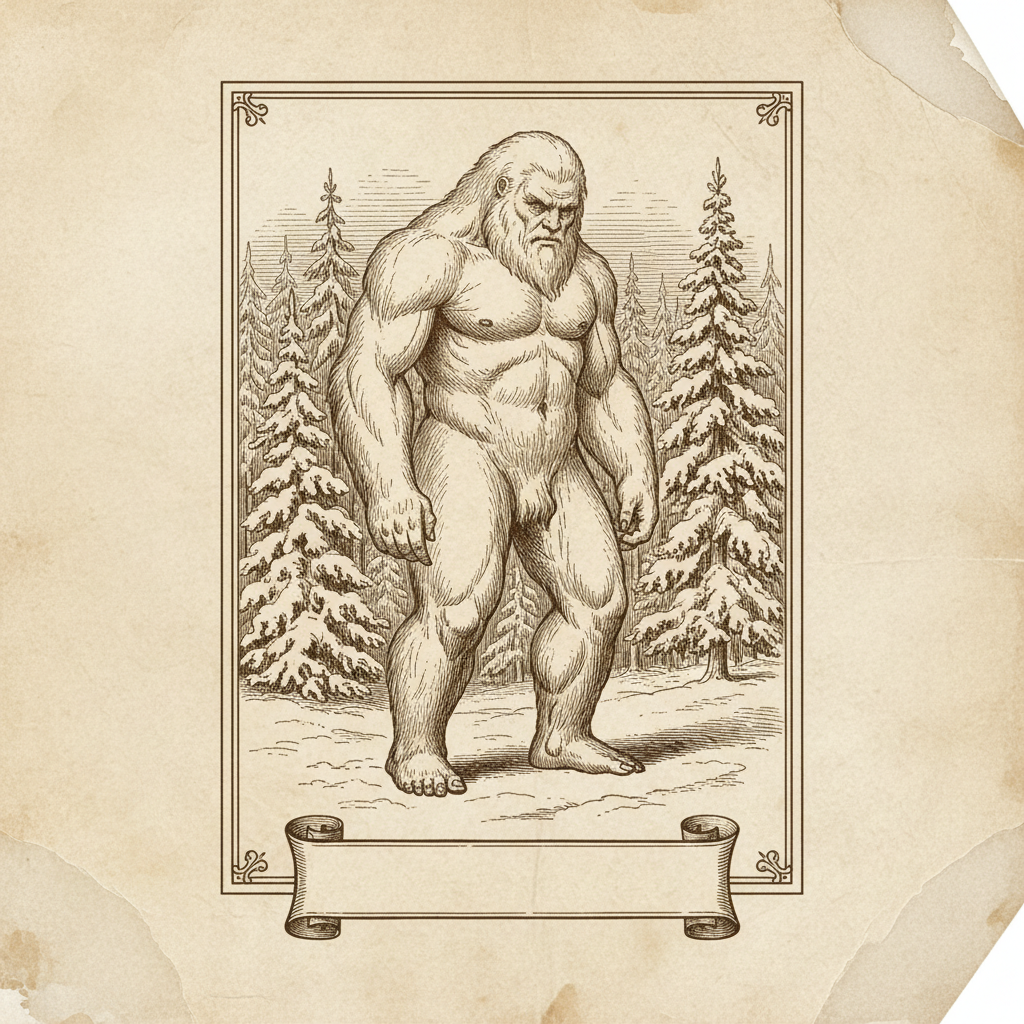
Appearance and body structure
Identity
Bigfoot, Yeti, and Yowie belong to one interbreeding species.
Overall appearance
Mostly human, with subtle ape-like facial features.
Body
Large, powerful build with strong muscles.
Hair
Thick body hair.
Feet
Broad and flexible.
Movement
Upright.
Bigfoot form
Brown to near-black hair, associated with forest and brush camouflage.
Yeti form
White or cream hair, associated with snowy camouflage.
Yowie form
Sandy-golden-brown hair, comparable in tone to a golden retriever.
Life history
Natural lifespan
Approximately 100–140 years.
Childhood
Humanlike early development.
Adulthood
Reached on a humanlike developmental timetable.
Later life
Aging slows in comparison with humans.
Biology
Hearing
Heightened.
Smell
Heightened.
Vision
Moderately better low-light vision.
Reproduction
The Bigfoot, Yeti, and Yowie regional populations can have children together.
Movement
Broad, flexible feet and upright locomotion are established features.
Magic and glamours
Established facts
No species-specific facts have yet been established.
Society and culture
Intelligence
Fully intelligent people, not mindless beasts.
Language
Can speak fluent English, and are capable of complex language.
Families
Typical households are relatively small — generally parents and children; extended relatives often live nearby rather than in the same household.
Partnerships
Some relationships last for life; others end. Bonded and non-bonded couples may exist within the species.
Professions
May pursue ordinary lives and work.
Individuals
Temperament and behavior are personal, not determined by species.
Folklore
Human observations and avoidance behavior contributed to distorted or incomplete descriptions.
Notable individuals
Established facts
No species-specific facts have yet been established.
Hard boundaries
What this entry must never become, however the story grows.
Bigfoot, Yeti, and Yowie must not be written as three reproductively isolated species.
Regional color differences must not be equated with different levels of intelligence or personhood.
The species must not be characterized as inherently monstrous or uniformly aggressive.
Bonding must not be made compulsory for every couple.
Do not promote previously proposed numerical height or weight ranges to canon.
Open questions
Unanswered on purpose. The journal decides these one question at a time.
Numerical adult height and weight ranges.
Precise ears, eyes, nose, and skin anatomy.
Additional regional variations and adaptations.
Exact adult maturity and visible aging milestones.
Strength, speed, endurance, skeleton, injury repair, scarring, pain, and temperature detection.
Thermoregulation, hydration, diet, sleep, pregnancy, and reproductive details.
Innate magic beyond the general possibility of individual soul bonds.
Glamours and species-specific concealment practices.
Detailed community structures and specific professions.
Named individuals and links to Olivia, Leif, Astrid, or other plot events.
Archivist's caution
Bigfoot, Yeti, and Yowie are one species; regional color differences say nothing about intelligence or personhood.
More open dossiers