
Brownies / Hobs / Lobs
Species 001 · Brownies, Hobs, and Lobs — one species, three regional names
One supernatural species carrying three regional names. Folklore made them household helpers; the archive records individuals — long-lived humanoid people with large rounded ears, prominent eyes, and no innate role at all, living among humans and in communities of their own the world over.
Developed — physical appearance, lifespan, maturation, and the onset of visible aging are established. Further biology and culture remain open.
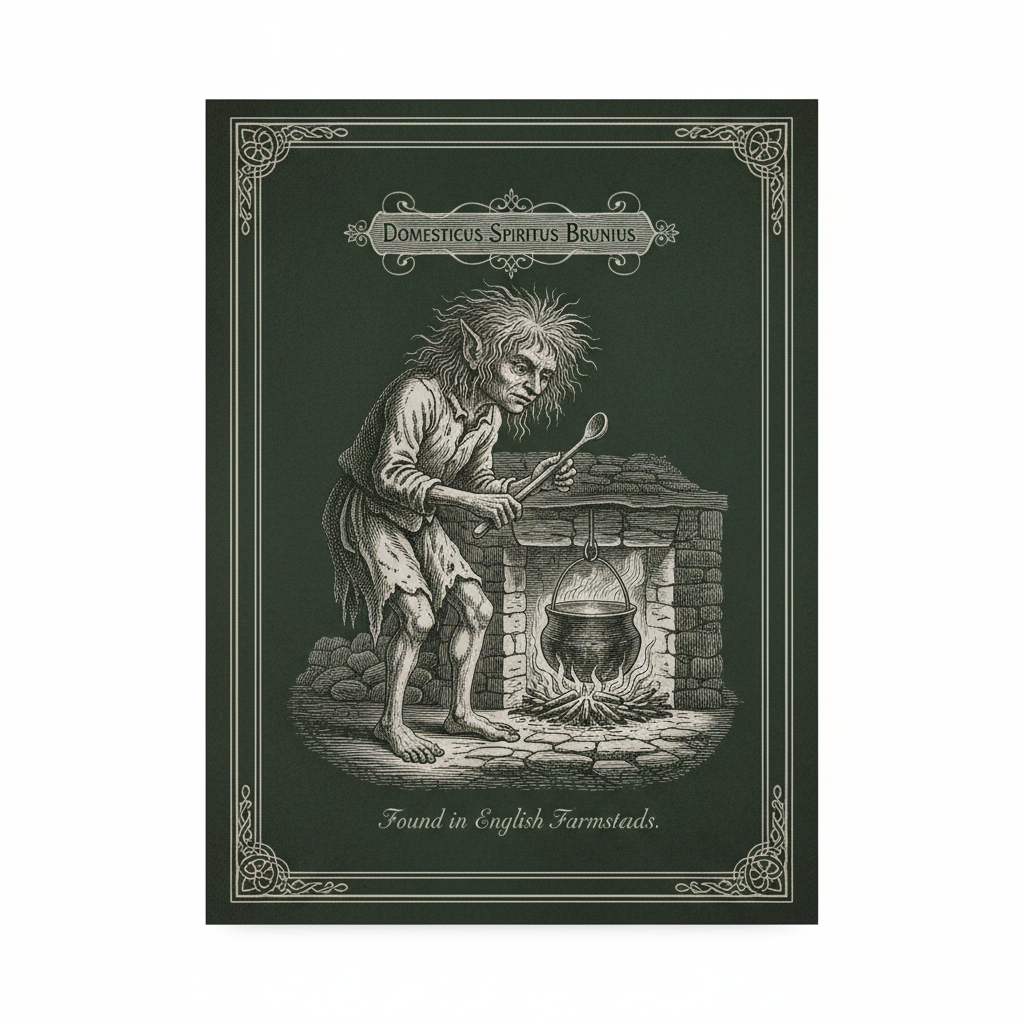
Appearance and body structure
Adult height
Typically 4–6 feet.
Build
Generally slender and wiry; individual body proportions vary naturally.
Face
Humanoid, with distinctive, pronounced facial proportions.
Ears
Naturally large and rounded rather than pointed; size and positioning vary between individuals.
Nose
Generally narrow and angular, with a defined bridge; individual variation is normal.
Eyes
Large and prominent relative to the face; predominantly brown, amber, green, or hazel — other naturally occurring colors are not excluded.
Hair
Naturally thick and often unruly; straight, wavy, curly, or tightly curled. Common colors include brown, dark blonde, auburn, and red; other natural colors may occur. Color is inherited.
Skin
Humanlike, with varied natural tones and textures; may carry freckles, moles, birthmarks, scars, and age-related changes.
Life history
Natural lifespan
Approximately 120–180 years — not immortal, and not immune to premature death.
Childhood
Infancy, childhood, puberty, and adolescence develop at approximately the human rate.
Physical adulthood
Generally reached at approximately 18–21 years.
Young adulthood
An extended period of relatively slow visible aging follows maturity.
Visible aging
Generally becomes more noticeable around 60–70 years, and may include graying hair and wrinkles. The transition is gradual, not sudden.
Later adulthood
Natural aging continues after visible changes begin.
Biology
Skin
Not inherently leathery or unusually rough; no enhanced skin resistance or healing has been established.
Strength
No species-specific strength advantage has been established.
Speed
No species-specific speed advantage has been established.
Endurance
No species-specific endurance advantage has been established.
Vision
No special visual ability has been established.
Senses
No species-specific sensory advantage has been established.
Health
Individuals remain vulnerable to injury and illness.
Magic and glamours
Glamours
May be used to conceal distinctive physical features. They alter perception, not physical anatomy — ears, noses, and other features remain unchanged beneath the disguise.
Prepared glamours
Can be obtained through supernatural commercial channels; some businesses serving human and supernatural customers provide them. Personal ability to create a glamour is not established for every individual.
Pigmentation
Eye color does not determine magical strength, and hair color does not determine magical ability.
Society and culture
Classification
Brownies, Hobs, and Lobs are regional populations of the same species; the names reflect ancestry, geography, and cultural traditions.
Communities
May live among humans or within supernatural communities worldwide.
Education
May attend human schools or supernatural educational institutions.
Professions
May pursue a wide range of careers.
Family
Relationships can span multiple generations — parents, grandparents, and great-grandparents may remain involved over many decades.
Disclosure
No universal supernatural law forbids revealing their identity to humans; concealment is primarily cultural, shaped by historical persecution.
Roles
No innate servant, domestic-worker, or caretaker role; no single personality or occupation is inherent to the species.
Notable individuals
The Keepers
Olivia Thorne's adoptive mother and father were both Brownies, and the two of them raised Olivia and her younger brother Leif in a stable, loving household in an ordinary neighborhood.
Their deaths
The Keepers died when Olivia was 22. The deaths were originally believed to be an accident.
Hard boundaries
What this entry must never become, however the story grows.
Brownies, Hobs, and Lobs must not be treated as three separate species.
Folkloric household-helper associations must not be mistaken for an innate compulsion.
No single face, hair color, skin tone, or body type exclusively identifies a Brownie, Hob, or Lob.
Longevity must not be equated with immortality.
Age 60–70 must not automatically be written as frailty or old age.
Glamours must not be depicted as changing actual anatomy.
Eye or hair color must not establish magical superiority.
The Keepers' longer lifespan does not negate their deaths.
Open questions
Unanswered on purpose. The journal decides these one question at a time.
Exact later-life rate of physical decline, and changes in health, strength, and endurance.
Immune function, illness, and recovery.
Reproductive biology, pregnancy, and marriage customs.
Inheritance of supernatural traits.
Species-specific hearing, smell, touch, and other senses.
Strength, agility, speed, stamina, and their limits, beyond the established absence of a special advantage.
Diet, hydration, metabolism, and food needs.
Sleep patterns.
Innate magic and its limits.
Regional physical differences and specific regional traditions.
The Keepers' ages, ancestry, and individual glamour use.
Exact family structures and cultural expectations.
Archivist's caution
Brownies, Hobs, and Lobs are one species. Their folkloric reputation as household helpers must not be mistaken for an innate compulsion, and no single face, hair color, skin tone, or body type identifies one.
More open dossiers